

DIY Home Improvement Market Size to Hit USD 1192.01 Billion at a CAGR of 4.21% by 2034 - Report by Zion Market Research (ZMR)
NEW YORK, USA, July 13, 2026 (GLOBE NEWSWIRE) -- Zion Market Research has published a new research report titled “DIY Home Improvement Market By Product Type (Building Materials, Tools and Equipment, Home Improvement Products, and Decor and Furnishings), By Project Type (Interior Renovations, Exterior Renovations, and Home Repairs & Maintenance), By Distribution Channel (Home Improvement Retailers, Online Retailers, Specialty Stores), and By Region - Global and Regional Industry Overview, Market Intelligence, Comprehensive Analysis, Historical Data, and Forecasts 2025 - 2034” in its research database.
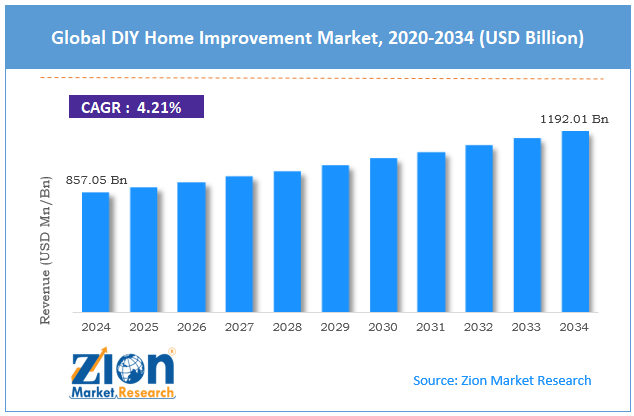
“According to the latest research study, the global DIY home improvement market size was valued at around USD 857.05 billion in 2024. The market is expected to grow at a CAGR of 4.21% and is anticipated to reach a value of USD 1192.01 billion by 2034.”
Get a Free Sample PDF of this Research Report for more Insights - https://www.zionmarketresearch.com/sample/diy-home-improvement-market
DIY Home Improvement Market Overview:
The do-it-yourself (DIY) home improvement market refers to the global sector focused on the retail sale of building materials, tools, decoration kits, and maintenance equipment directly to property owners who execute residential modifications, upgrades, or structural repairs independently. Instead of hiring professional contractors, individuals engage in hands-on tasks to customize their living environments, fix routine structural issues, and execute architectural improvements. This market supports a diverse ecosystem of self-directed projects ranging from basic wall painting and floor installations to advanced kitchen redesigns and external property landscaping.
The market dynamics are characterized by several socioeconomic forces shaping global consumer purchase habits. The growth drivers are heavily fueled by rising affordability pressures and economic uncertainty that prompt homeowners to enhance existing properties rather than purchase new real estate. The primary restraints include high upfront material expenses and specialized tool acquisition costs that can challenge lower-income household participation. The opportunities are strongly driven by the rapid consumer adoption of easy-to-install smart home systems and eco-friendly structural materials. The challenges persist in the form of widespread skill gaps and safety concerns among casual consumers attempting to complete complex structural, electrical, or plumbing projects without professional certification.
Report Scope:
| Report Attribute | Report Details |
| Market Size in 2024 | USD 857.05 Billion |
| Market Forecast in 2034 | USD 1192.01 Billion |
| Growth Rate | CAGR of 4.21% |
| Base Year | 2024 |
| Forecast Years | 2025- 2034 |
| Key Companies Covered | Home Depot, Lowe’s, Kingfisher plc, ADEO Group (Leroy Merlin), Menards, Ace Hardware, Stanley Black & Decker, Robert Bosch, Sherwin-Williams, PPG Industries, 3M, Techtronic Industries, Husqvarna Group, Sodimac, Mr. Bricolage, and others. |
| Segments Covered | By Product Type, By Project Type, By Distribution Channel, and By Region |
| Regions Covered | North America, Europe, Asia Pacific, Latin America, and the Middle East & Africa |
| Customization Scope | Avail customized purchase options to meet your exact research needs. |
Directly Purchase a Copy of the Report | Quick Delivery Available - https://www.zionmarketresearch.com/buynow/su/diy-home-improvement-market
Key Insights from Primary Research
- As per the analysis, the DIY home improvement market share is likely to grow at a CAGR of around 4.21% between 2025 and 2034.
- The DIY home improvement market size was worth around $857.05 billion in 2024 and is estimated to hit approximately $1192.01 billion by 2034. Due to a variety of driving factors, the market is predicted to rise at a significant rate.
- The market is driven by rising household optimization trends paired with a massive democratization of construction knowledge through digital step-by-step guides and online video tutorials.
- Based on the Product Type, the Tools and Equipment segment dominated the market with a share of over 25% because basic manual and powered implements are essential prerequisites for performing any physical structural improvements.
- Based on the Project Type, the Interior Renovations segment held the largest share of approximately 42% because bathroom upgrades, kitchen enhancements, and room paint modifications offer immediate visual personalization and property valuation gains.
- Based on the Distribution Channel, the Home Improvement Retailers segment dominated with a share of 54% due to the broad consumer preference for physically examining heavy construction materials and receiving in-store consultation.
- North America dominated the global market with a share of 37% in 2024 because of a mature regional culture of independent home maintenance, high domestic homeownership rates, and a dense network of large-format warehouse retail stores.
DIY Home Improvement Market: Dynamics
Growth Drivers
How are affordability pressures & economic uncertainty fueling the DIY home improvement market?
Economic pressures such as inflation, high mortgage rates, and stagnant real estate markets prompt modern property owners to optimize their current spaces rather than move to new homes. Buying a new house or hiring professional contractors involves significant financial strain, making independent renovations a more practical option. Homeowners choose to remodel individual areas gradually, avoiding heavy debts while steadily increasing the value of their property. Additionally, cost-conscious buyers across various income brackets find that taking on home improvement projects themselves saves substantial money on labor. The savings from avoiding professional labor fees allow individuals to invest in higher-quality materials or better tools, which boosts retail sales for DIY suppliers. This budget-focused mindset helps the market maintain stable demand even during periods of broader economic slowdown.
How is the DIY home improvement market driven by digital accessibility & online knowledge resources?
The fast spread of digital instructional media, interactive smartphone apps, and online project planning tools has significantly reduced the barriers to entry for casual home renovators. Popular social media platforms like TikTok and YouTube act as virtual learning spaces where millions of people pick up practical skills like tiling, painting, and basic carpentry. This widespread access to clear information builds consumer confidence, encouraging individuals to take on complex home updates entirely on their own. Moreover, advanced digital tools like mobile augmented reality (AR) planning applications allow consumers to preview how paint colors, flooring types, or furniture layouts will look in their homes before making a purchase. This integration of helpful retail technology removes much of the guesswork from planning independent projects. As a result, consumer purchasing journeys become smoother, leading to increased transaction values for home improvement retailers worldwide.
Restraints
Do upfront tool & material costs negatively impact the market progress?
The heavy initial capital needed to buy high-grade construction materials and specialized power equipment remains a major barrier for casual home improvement enthusiasts. While taking on projects independently reduces professional labor costs, the upfront expense of high-quality tools can be tough to manage for occasional buyers. If a specialized piece of equipment is only needed for a single task, purchasing it increases the total cost of the project, which can discourage consumers from starting.
This financial hurdle is particularly challenging for younger homeowners and lower-income households working with tight discretionary budgets. Unlike major professional contracting companies, typical consumers rarely have access to commercial credit lines or flexible financing options when buying raw building materials. Consequently, strict budget limits often hold back consumers from taking on large, multi-room renovations, which slows sales growth for premium product lines.
Does a lack of free time among urban workers hold back independent home improvement activities?
The busy schedules and long working hours common among modern urban professionals significantly limit the amount of personal time available for demanding home improvement projects. Large renovations, such as installing new flooring or remodeling a kitchen, require a substantial commitment of consecutive hours that many busy workers simply cannot spare. Faced with limited free time on weekends, many property owners choose to delay property maintenance or save up to hire professional services instead.
This time scarcity is further compounded by the growing complexity of balancing family obligations and social commitments in metropolitan areas. When individuals feel overwhelmed by their weekly routines, physical labor projects around the house are often pushed down the priority list. This ongoing lack of personal time presents a structural challenge for the market, as it restricts DIY activities primarily to small, quick tasks rather than major structural upgrades.
Opportunities
How do smart home integration & plug‑and‑play tech create promising avenues for the DIY home improvement industry growth?
The growing popularity of connected smart home systems and simple, tool-free installation options offers an excellent expansion pathway for the consumer home improvement sector. Modern manufacturers are actively creating advanced home automation devices, such as smart thermostats, keyless security locks, and programmable indoor lighting, that do not require professional wiring to set up. These user-friendly systems appeal strongly to tech-focused consumers who want to upgrade their properties without dealing with complex technical installations.
By bundling these smart devices into comprehensive, easy-to-follow installation kits, retailers can attract customers who might otherwise feel intimidated by home improvement projects. Strategic partnerships between major retail store chains and top consumer electronics brands help make these advanced tech products highly visible and accessible. This trend successfully blends modern lifestyle technology with hands-on property improvement, driving steady growth across high-margin product categories.
Can the rising demand for eco-friendly building materials open new avenues for market value expansion?
The global consumer shift toward environmental sustainability offers a highly profitable opportunity for manufacturers to update their product selections with green alternatives. Today's environmentally conscious property owners actively seek out low-VOC interior paints, certified sustainable lumber, recycled insulation materials, and water-saving plumbing fixtures for their homes. Outfitting retail locations with dedicated eco-friendly product sections allows businesses to capture interest from climate-conscious buyers who are willing to pay more for sustainable options.
Building a product pipeline around verified green certifications also helps retailers align with modern residential energy-saving goals. Consumers are eager to implement projects that cut down on daily utility expenses, such as adding energy-efficient window seals or reflective roof coatings. Focusing on these high-efficiency, sustainable materials helps businesses build a premium brand image that stands out in a crowded retail market.
Challenges
How do skill gaps and safety concerns regarding complex home projects challenge the industry?
The significant variation in technical skill levels among typical property owners poses a major challenge for expanding the home improvement industry into complex project categories. Tasks that involve structural adjustments, high-voltage electrical wiring, or main plumbing lines require a level of precision that casual consumers often lack. When individuals attempt these advanced projects without proper training, they run the risk of improper installations that could lead to property damage or create safety hazards.
These technical challenges can lead to negative consumer experiences, generating frustration that discourages individuals from trying independent projects in the future. Furthermore, growing regulatory oversight regarding local building codes and strict safety permits can make homeowners hesitant to modify their properties without professional guidance. Retailers must invest continuously in creating educational videos, hosting in-store training workshops, and offering clear product support to help consumers overcome these skill gaps safely.
Does intense competition from professional home renovation service providers limit consumer market share?
The widespread availability and convenient scheduling offered by professional contracting firms, independent handymen, and specialized home remodeling services present a tough competitive challenge for the self-directed market. Many busy or affluent property owners prefer the reliability and speed of hiring certified professionals over spending their own time on physical labor. When professional services offer affordable rates or flexible financing, consumers are more likely to outsource their home maintenance tasks completely.
This competitive pressure is especially strong in segments like structural exterior repairs and roofing updates, where professional equipment is necessary for safety. Additionally, the fast turnaround times achieved by experienced commercial crews can make independent projects seem slow and disruptive to daily household routines. To keep consumers engaged, the self-directed retail sector must constantly highlight the personal satisfaction, custom design freedom, and direct labor cost savings of hands-on home improvement.
Browse the full “DIY Home Improvement Market By Product Type (Building Materials, Tools and Equipment, Home Improvement Products, and Decor and Furnishings), By Project Type (Interior Renovations, Exterior Renovations, and Home Repairs & Maintenance), By Distribution Channel (Home Improvement Retailers, Online Retailers, Specialty Stores), and By Region - Global and Regional Industry Overview, Market Intelligence, Comprehensive Analysis, Historical Data, and Forecasts 2025 - 2034” Report at https://www.zionmarketresearch.com/report/diy-home-improvement-market
DIY Home Improvement Market: Segmentation
The DIY Home Improvement market is segmented by product type, project type, distribution channel, and region.
Based on Product Type, the DIY Home Improvement market is divided into Building Materials, Tools and Equipment, Home Improvement Products, Décor and Furnishings, and others. The Tools and Equipment segment represents the absolute dominant category within the marketplace. This dominance is underpinned by the simple reality that carrying out any structural renovation, repair, or cosmetic project requires reliable manual or power tools, making them the initial purchase for any consumer journey. The steady necessity of this product line helps drive the overall market forward by sustaining high-capacity production orders for manufacturing plants globally. The second most dominant category is Building Materials, driven by continuous volume purchases of lumber, cement, drywall, and structural components for foundational home improvement tasks.
Based on Project Type, the DIY Home Improvement market is divided into Interior Renovations, Exterior Renovations, Home Repairs & Maintenance, and others. The Interior Renovations segment stands as the leading application category, holding a major portion of global market revenue. This segment's leading position is driven by the immediate comfort and high visual impact that indoor remodeling projects—such as kitchen updates, bathroom tiling, and bedroom repainting bring to daily family life. The high focus on maximizing indoor living environments allows this segment to act as the primary engine for overall market volume growth. The second most dominant category is Home Repairs & Maintenance, which represents a stable, non-discretionary stream of purchases for fixing routine plumbing leaks, electrical fixtures, and structural wear.
Based on Distribution Channel, the DIY Home Improvement market is divided into Home Improvement Retailers, Online Retailers, Specialty Stores, and others. The Home Improvement Retailers segment, which includes large-format warehouse stores, stands out as the most dominant distribution network globally. Its leading market position is due to the convenience of single-roof shopping for heavy materials, along with the value of in-person product inspection and direct advice from knowledgeable store staff. The second most dominant distribution channel is Online Retailers, which is experiencing rapid growth as tech-savvy consumers increasingly appreciate the convenience of doorstep delivery for compact power tools, hardware kits, and decorative fixtures.
Regional Scope:
Why will North America continue to dominate the global market during the projection period?
North America is projected to maintain its leading position in the global DIY Home Improvement market through the forecast period, supported by a well-established independent home care culture and high rates of residential homeownership. The region's dominance is primarily driven by the United States, where large-format home improvement warehouse chains are highly integrated into suburban neighborhoods, keeping tools and materials easily accessible. Additionally, an aging housing stock across many states creates a continuous need for regular structural updates, maintenance, and cosmetic upgrades. The widespread availability of residential garages and personal workshops gives consumers the physical space needed to store tools and complete complex projects safely. Furthermore, healthy regional disposable incomes and a strong demographic shift toward millennial homeownership support steady investments in high-end tools and smart home installation kits.
The Asia-Pacific region is anticipated to experience the highest growth rate during the forecast period. Countries like China and India are undergoing rapid urbanization, leading to an expanding middle class and an increasing desire for personalized urban apartments. The fast development of localized digital e-commerce platforms and efficient delivery networks makes it much easier for city residents to purchase compact power tools, paint kits, and decorative materials. Moreover, rising disposable incomes allow younger, tech-savvy consumers to invest more in updating their living spaces to reflect modern lifestyle trends. The expansion of regional home improvement retail networks and the increasing availability of affordable, user-friendly tool packages further accelerate the regional market's expansion.
Recent Developments
- In January 2026, The Home Depot completed the strategic acquisition of a prominent specialized supply chain network to streamline the delivery of heavy building materials directly to residential job sites.
- In October 2025, Lowe's Companies announced the rollout of an advanced AI-powered mobile app feature designed to help DIY consumers calculate exact material measurements and generate step-by-step project guides.
- In April 2026, Kingfisher plc introduced a new line of fully eco-friendly, ultra-compact power tools featuring interchangeable battery systems designed to reduce electronic waste in the consumer market.
Request For Customization on This Report as Per Your Requirements - https://www.zionmarketresearch.com/custom/10255
DIY Home Improvement Market: Competitive Landscape
The report contains qualitative and quantitative research on the global DIY home improvement market, as well as detailed insights and development strategies employed by the leading competitors.
Some of the main players in the global DIY home improvement market include;
- Home Depot
- Lowe’s
- Kingfisher plc
- ADEO Group (Leroy Merlin)
- Menards
- Ace Hardware
- Stanley Black & Decker
- Robert Bosch
- Sherwin Williams
- PPG Industries
- 3M
- Techtronic Industries
- Husqvarna Group
- Sodimac
- Mr. Bricolage
What are the key trends in the DIY Home Improvement Market?
The Rising Proliferation of Eco-Friendly and Health-Conscious Materials
A major trend impacting the market is the consumer demand for sustainable, clean-label interior building products. Shoppers actively seek out certified non-toxic paints, bio-sourced flooring options, and organic insulation materials to create healthier indoor living environments for their families.
The Rapid Integration of Augmented Reality into Product Selection
Modern home improvement retailers are rapidly integrating advanced augmented reality tools into their online storefronts. This technology trend allows consumers to use their smartphones to see exactly how new paint colors, wall textures, or flooring designs will look in their physical rooms before purchasing the materials.
The global DIY home improvement market is segmented as follows:
By Product Type
- Building Materials
- Tools and Equipment
- Home Improvement Products
- Décor and Furnishings
By Project Type
- Interior Renovations
- Exterior Renovations
- Home Repairs & Maintenance
By Distribution Channel
- Home Improvement Retailers
- Online Retailers
- Specialty Stores
By Region
- North America
- The U.S.
- Canada
- Europe
- France
- The UK
- Spain
- Germany
- Italy
- Rest of Europe
- Asia Pacific
- China
- Japan
- India
- Southeast Asia
- Rest of Southeast Asia
- The Middle East & Africa
- GCC
- South Africa
- Rest of the Middle East & Africa
- Latin America
- Brazil
- Argentina
- Rest of Latin America
Request Free Brochure of the Global DIY Home Improvement Market @ https://www.zionmarketresearch.com/requestbrochure/diy-home-improvement-market
Key Questions Answered in This Report:
- What is DIY home improvement?
- Which key factors will influence the growth of the DIY home improvement market over 2025-2034?
- What will be the value of the DIY home improvement market during 2025-2034?
- What will be the CAGR value of the DIY home improvement market during 2025-2034?
- How are market trends and consumer preferences evolving in the DIY home improvement market?
- How will macroeconomic factors impact the DIY home improvement market in the coming years?
- Which region will contribute notably to the DIY home improvement market value?
- Which are the major players driving growth in the DIY home improvement market?
- How is the competitive landscape structured in the DIY home improvement market?
- What can be expected from the global DIY home improvement market report?
Browse Other Related Research Reports from Zion Market Research
- Sun Protection (UPF) Clothing Market By Type (Hats & Caps, Shirts, T-shirts, & Tops, Pants & Shorts, and Swimwear), By End-User (Women, Men, Children, and Infants), By Distribution Channel (Offline Retail, Online Retail, and Department Stores), By Fabric Type (Blended Materials, Natural, and Synthetic), and By Region - Global and Regional Industry Overview, Market Intelligence, Comprehensive Analysis, Historical Data, and Forecasts 2025 - 2034
- Soccer Shoes And Cleats Market By Type (Indoor, Turf, Multi-Ground, Firm Ground, Soft Ground, and Artificial Ground), By End-User (Women, Men, Children, Professional Players, and Recreational Players), By Distribution Channel (Brand-Owned Stores, Online Retail, Factory Outlets, Third-Party Marketplaces, and Supermarkets), By Price Range (Premium, Mid-Range, and Affordable), and By Region - Global and Regional Industry Overview, Market Intelligence, Comprehensive Analysis, Historical Data, and Forecasts 2025 - 2034
- Life Saving Appliances Market By Product Type (Life Jackets, Life Rafts, Lifebuoys, Emergency Breathing Systems, and Others), By End User (Maritime, Aviation, Oil & Gas, and Others), By Distribution Channel (Online Stores, Specialty Stores, and Others), and By Region - Global and Regional Industry Overview, Market Intelligence, Comprehensive Analysis, Historical Data, and Forecasts 2025 - 2034
- Commercial Fitness Equipment Market By Type of Equipment (Strength Training Equipment, Cardiovascular Training Equipment, and Others), By End-Users (Health Clubs/Gyms, Hotels, Corporate Offices, Medical Centers, and Others), By Price Point (Premium/Luxury and Standard), and By Region - Global and Regional Industry Overview, Market Intelligence, Comprehensive Analysis, Historical Data, and Forecasts 2025 - 2034
- Home Appliances Market By Type (Major Appliances, Small Appliances, Smart Home Appliances), By Distribution Channel (Supermarkets & Hypermarkets, Specialty Stores, Online/E-commerce, and Others), and By Region - Global and Regional Industry Overview, Market Intelligence, Comprehensive Analysis, Historical Data, and Forecasts 2025 - 2034
About Zion Market Research:
Zion Market Research is a leading market research organization offering industry expertise and scrupulous consulting services to clients for their business development. The reports and services offered by Zion Market Research are used by prestigious academic institutions, start-ups, and companies globally to measure and understand the changing international and regional business backgrounds.
Contact Us:
Zion Market Research
USA/Canada Toll Free: 1 (855) 465-4651 | Newark: 1 (302) 444-0166
India: +91 7768 006 007 | +91 7768 006 008
Email: sales@zionmarketresearch.com | Web: https://www.zionmarketresearch.com/
Follow Us on - LinkedIn | X | Facebook | Pinterest | YouTube


Legal Disclaimer:
EIN Presswire provides this news content "as is" without warranty of any kind. We do not accept any responsibility or liability for the accuracy, content, images, videos, licenses, completeness, legality, or reliability of the information contained in this article. If you have any complaints or copyright issues related to this article, kindly contact the author above.
